Showing posts with label dvd. Show all posts

Thursday, March 29, 2012

What is Berserk: Golden Age Arc?


Director: Toshiyuki Kubooka
Production: Studio 4°C
Writer: Ichirō Ōkouchi
Music: Shirō Sagisu and Susumu Hirasawa
Release date: June 23, 2012

An action horror manga spanning decades of serialization; Berserk stars Guts, a man cursed since birth to live only a life of war and battle, and focuses on his life through the years he was a member of an elite mercenary group. Started in 1990, and still running, the manga has been reworked into several other forms: novelization, several video games, and an anime. To this day, the biggest complaint fans have had regarding the games and anime was that there wasn't enough of it; these additions to Berserk’s main story only follow one arc from the story, and that there hasn't been any new material to keep their fancy since the PS2 game released in 2004. Well, the long wait is almost over, and it was totally worth it.

In September of 2010, it was announced that a new movie project, titled "Berserk: Golden Age Arc" would be released as a trilogy, covering the back story of Guts in glorious high definition and superior movie production quality. On February 4th 2012, Part 1 was released, and many a fan watched in euphoric bloody joy at the cinematic opening to Guts' life. Many others who didn't know what "all the hoo-haa" was all about suddenly found themselves clearing the manga stores out of their back issues to catch up on all that they missed. The real wait, however, is for the 23rd of June when Part 2 is released in Japanese theaters. While Part 1 served as a nice opening and introduction to the characters and back story, Part 2 is the heart and crux of the legend, where the plots of the future are established and the points of notoriety are made. The release date for the conclusive Part 3 has yet to be announced, aside from "later in 2012", but suffice to say that after the record-breaking sales in movie theater tickets expected this summer, that everyone will be on the watch-list for the fall showings.

Coming soon to Japanese theaters: Berserk: Golden Age Arc 2

Berserk: Golden Age Arc 2 trailer

Thursday, September 29, 2011

What is Usagi Drop?

Usagi Drop
Writer - Yumi Unita
Director - Kanta Kamei
Production - Studio Fuga
Music - Suguru Matsutani

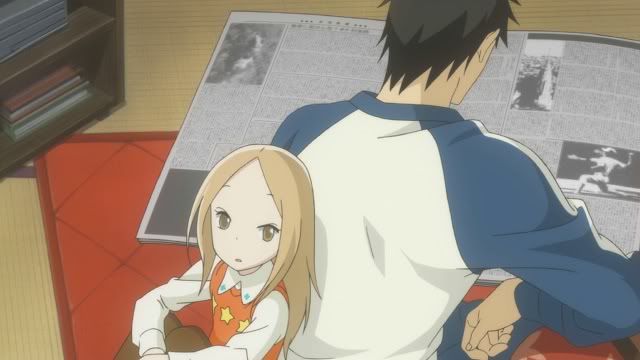
Going home from his grandfather's funeral, thirty-year-old Daikichi is floored to discover that the old man had an illegitimate child with a younger lover. The rest of his family is equally shocked and embarrassed by this surprise development, and not one of them wants anything to do with the silent little girl, Rin. In a fit of anger, Daikichi decides to take her in himself. As Daikichi nurtures Rin, he started to understand the struggle while at the same time the joy of parenting.

The word of the day here is "Sentimentality". Familial controversy and comedic gags related to her legal status as his 'aunt' are put aside early to make room for the real purpose of the story, which is "Child Raising". Daikichi knows nothing about raising a little girl and he must learn, frequently through last minute desperate endeavors, how to do so. Rin on the other hand is a 6 year old girl, not even in Elementry school yet, who is trying to understand the death of her real father while adapting to life under her new bungling guardian. Through all the little firsts and experiences and trials experienced by the duo, a very real father-daughter love begins to blossom. The show really does focus on the little things, to such a degree that it might be taken as an "idiots guide to child raising". Little things you wouldn't think about normally, like immunization shots, enrolling in primary school, grocery shopping, or the troubles of co-habitation.

The animation quality is difficult to swallow at first. The first moments of the first episode lend to the thought "how could something this grainy possibly be good or entertaining?" That thought quickly disappears as both story and animation smooth out into a near-real life quality. The background music is phenomenal, adding to and sometimes setting the sheer emotion that permeates through the entire series.

I still cannot believe how addictively entertained I was by this show. Maybe it was because of the nature of the drama, but soon in I was wrapped in the warm blanket of platonic romance and crying for precious more seconds of familial love. For being the most real-life fiction I have ever encountered I give this show an unprecedented Perfect 5 out of 5.

'Ben

Friday, April 22, 2011

J1 Culture Force Anime Event in detail...

J1 Culture Force Anime Event!! A first time spectacle for J1 Studios’ fans that love anime and manga. It was held at the Hawthorne Cultural Center: on 12th and Carpenter in South Philadelphia. Mrs. Theresa Williams, the Director of the facility and Mr. Windle, one of the supervisors were delighted to have such a multi-faceted, cultural event held at a center that thrives off diversity. The event was broken into segments for trivia, musical performances, and home movie premier of “Sword of the Stranger.” All the while artists were seated at their commission table; gamers had their fill of Marvel vs. Capcom 3 via Playstation 3, and a space for Yu-G-Oh fans to dual each other. The event was graciously catered by Maru Global with an assortment of their famous pancake balls known as “takoyaki.”

            For the trivia, participators were placed into groups of five that numbered in Japanese. Example: Group one was “ichi” and group two was “ni.” This portion of the event started off a little disjointed but became quite rush once the questions were being asked. The trivia proved to be a challenge only after eight or so questions though, the age of contestants ranged from 13-26 years old. Ultimately, group “San” became victorious after they trudged through an array of tie-breaker questions. The group members of team “San” are part of the Community College of Philadelphia’s Anime Club. They won the first three manga volumes of Samurai Deeper Kyo and Wayne P. Lammers Japanese-English Translation Book.            

            Agumon Scarf was the musical talent for the evening with rousing support from family and friends. The band consists of five young men that are all still in high school. Even their manager, Basheer, known as Bazie, still attends high school. They showed no fear, as they were pumped full of energy during their performances. The band played the second season opening of Narurto, “Haruka Kanata”, as well, as originals songs like “Kenturo” and “Zach Fair.”

            The artists at the commission table were busy interacting with each other and who ever stopped by to see their creative talent in action. Their skill leveled ranged from silly cartoon characters to very detailed drawings that you commonly see in American and Japanese comics. For some if not most, it was the first time they have exposed their talent to the public. The gamers showed off their flare for card games with a few matches of Yu-Gi-Oh or their skill with a PS3 game controller when dueling on MVC 3. Others displayed their liking for Japanese pop fashion and anime with their cosplay outfits or usual clothing attire.

            Though the night was winding down, those who were able to stay watched “Sword of the Stranger.” Directed by Masahiro Ando, the featured filmed surrounded a swordsman with no name and a golden-haired assassin as circumstances draw them toward a mysterious young boy. If you happen to be a fan of Samurai X/Rurouni Kenshin then, this movie is a must-see. Others who managed to stay longer and did not watch the movie, conversed with members and guests of the event.
            Mrs. Williams was so taken by the festivities that she was inspired to design a bread bowl that represented the crazy excitement the event brought to the center. Also, she and Mr. Windle were honored to allow J1 Studios use the recreational center as its permanent home to host further anime events and the like. All members and fans are allowed to use the facilities of the center during hours of operations after first, consulting a time frame with either Mrs. Williams or Mr. Windle.

            Interesting enough, guests were still arriving even up to the very end. The all around support from members, fans, and guests encourage more fun-filled times to arise. Overall, the event was a success for its first running but there is always room for improvement.

To see more photos click HERE.

Tuesday, April 12, 2011

Spring Anime Review (Part 1)

There is 4 times a year that the Japanese release new Anime, correlating with the seasons. Of the 4 seasons, Summer and Winter are typically filled with filler anime, titles that are cheep, easy, and not very important, in order to fill the timeslots with so-called "new material", until the important big-named titles can be released in the Spring and Fall seasons. Within that pretext, the Winter season (released in January), the season of Transition where kids graduate school and people get new jobs, is the season that collects some of the worst Anime's of the year. Not counting a few gems that persisted, this last winter season managed to live up to that image with overused concepts and poorly executed ideas and terrible production budgets.
On the other side of that coin is the Spring season. Spring, the season of new beginnings (April, when the School year starts) is typically the season that gets the very best titles to be expected throughout the year. With that in mind, it is with high hopes that I dive into the budding premier season of new Anime.  In the previews, there were quite a number of big titles to look forward to, and the others had interesting premises, but a preview never does the title justice one way or another.

----

Battle Girls - Time Paradox
2 out of 5


Gurk! It's bad! That has to be some kind of a fluke! Well, it's not the worst anime I've seen yet, but so far I can only hope that this one was made intentionally bad to help prop up the majesty of the titles to follow.

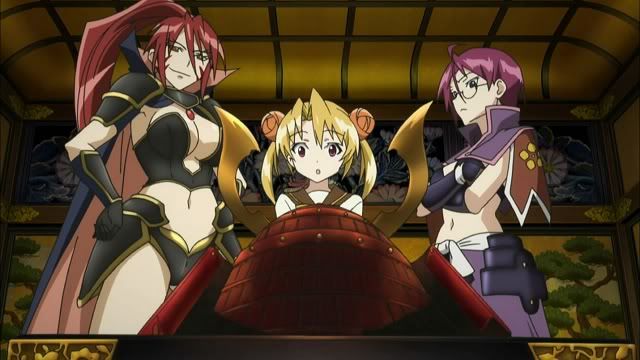
A high school girl named Hideyoshi (after the famous general from the warring states period of 16th century Japan) accidentally gets sucked back in time to the very same period by her Teacher, who in turn tried to go back in order to change history in another warlords favor. While in the past, Hideyoshi meets and teams up with all the famous lords of the period (who are all sexy young women) and ends up changing history anyway as she is swept along by the creation of it.

The purpose of this anime seems to be to teach Japanese History to its' viewers, and in that regard it is a success. Names, dates, places, and events are all kept historically accurate, except where the anime deviates, however they take the time to properly explain what "really" happened in order to add to the tension of that event having been changed. The characters, too, are all very colorful and memorable and pleasing to the eye.

This is where the show falls apart. The modern girl falling into the past idea has been used too many times before (Inuyasha, Escaflowne, Magic Knight Rayearth to name a few), and Hideyoshi is the worst of the bunch in how she seems to not even notice. You'd think that the lack of electricity, paved roads, cars, or buildings made of anything but rice would tip her off, or that maybe she'd be a little understanding when everyone around is wearing armor and wielding swords and killing each other but doesn't seem to understand what a "cell phone" is. The historical badasses being represented by sexy ladies thing was done before, too (Ikkitousen in this case), but the presentation is another failure. All the characters are sexy women, but their looks are never exploited. Not a single panty shot, no attention given to busts, no bath scenes, but plenty of bulky armor and baggy clothing around to protect their modesty.

The action scenes were almost nonexistent, consisting of an old movie trick to make a character look badass (appearing through a fire) and nothing else. The rest of the time was spent in dialogue or an expose about how terrible Hideyoshi thinks her life is. Katanagatari proved that Dialogue can be the winning formula of a ragingly successful title, but Battle Girls proved that it can be quite the opposite, too. Dialogue was simple, repetitive, poorly acted, and many times so out of character that I began to wonder if this wasn't in fact written by a lousy fanfic author?
The character designs are appealing enough, and I like the history lesson involved, so I can only hope that the rest of it can catch up. 2 out of 5.

SKET Dance
1 out of 5


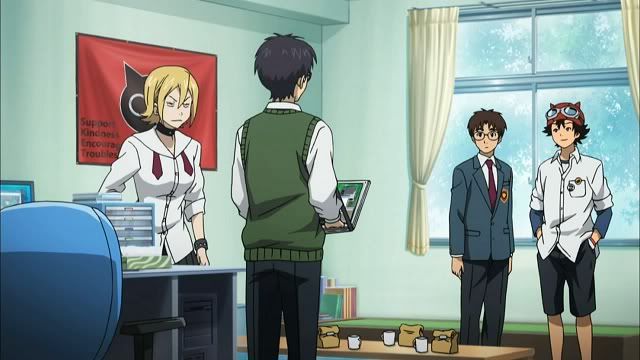
FOWL!! I Cry FOWL!  SKET Dance is such a blatant and unrepentant rip-off of PCP (Perfect Crime Party) From the manga Bakuman. If you haven't read that far into Bakuman, first of all: Shame on you. Second: let me break it down.  PCP is about these three kids (two guys and a girl, one of the guys wears glasses and has cell-phone accessories) who perform amateur crimes (and gets away with it). SKET Dance is about these three kids (two guys and a girl, one of the guys wears glasses and has a computer) who perform amateur anti-crimes (helping people...and gets away with it).
A major difference is the protagonist of SKET dance, who is this plain, ordinary, shy, and nerdy Transfer student who get's sucked into the SKET clubs antics.  This guy is so plain and ordinary that I nearly blanched the very first moment I saw him, and did blanch on the second and subsequent moments. It's like they took the nerdiest dweebs to ever be bullied and blended them into a nearsighted twerp so pathetic that *I* want to bully him, and I abhor bullying.

The first episode consists of this one expose into the thoughts of the protagonist: "I'm a nervous shy kid who transferred into a new school and doesn't know anyone. On the first day however, the cool kids came up to me and invited me to be cool with them in the volunteer club! :-)" Need I say more? I shall. The art is ordinary and plain. The acting is half-assed like the Seiyu (voice actors) just didn't give a damn and weren't being paid enough. The character designs are overused and blend into the background (not to mention the sheer blaspheme of copying PCP so directly). The girl was rather pretty I'll admit, and she talked so openly and invitingly with the nerd (Shock!) but everything else just falls into the pits of failed plagiarism.

I rarely give a title 1 out of 5, but this one really deserves it, even if you discount the "ripoffness". The only reason I didn't give it a 0 out of 5 is because the characters spend a lot of time doing random acts of insanity out of boredom, which I wholeheartedly approve of.

Nichijou (My Ordinary Life)
5 out of 5


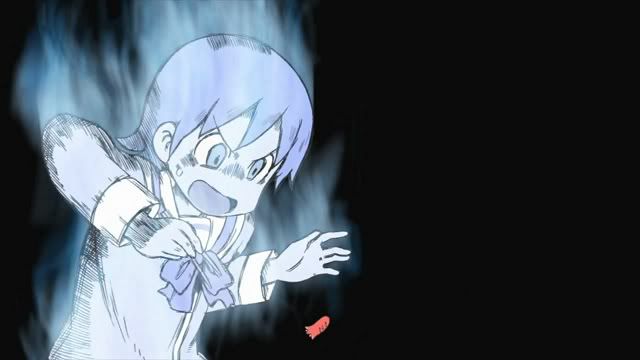
My Ordinary Life is exactly what the title says. The daily ordinary common occurrences around the life of some high school students, and some people in the neighborhood. Kinda like LuckyStar, Azumanga Daioh, and Minami-ke.  That is to say, if accidently bumping into someone on the street causes 25 megaton nuclear explosions and Marching on Washington in violent protest because someone voiced disapproval at riding a goat to school is normal.

Nichijou could very well be a skit from Who's Line is it Anyway brought to anime life. Certain every day logics like Going to School Every Morning and Eating a Variety of Foods to be Healthy are maintained, but everything else is taken to the very extremes of exaggeration, and then treated seriously. The aforementioned nuclear explosion literally threw the two bumpers to the other sides of the city, and debris managed to land in a suitably comical way on the head of yet someone else.

The art style is simple, which sometimes slips into grainy as the tension of the moment calls for it. For a comical title, the art is perfect. Breezy enough that nothing absurd would necessarily be considered out of place, but solid enough that the absurdities in the art itself can be treated as intentional, such as the wooden blocks used to tie up that one girls hair. The voice acting as well lends itself to the casual air of the style. Most characters sound like the extremes of the "moe" archetype, but pull off real emotion and shock as the scene calls for it. The Background music is probably one of the best features. Light and flimsy, like the comical orchestration behind a Loony Toons cartoon, but performed with the sheer quality of a Disney product. It does wonders to noticeably enhance the mood without synching up to the action like a musical.

The only problem I've had with this anime so far is the pacing of the gags. The gags are great and somewhat unexpected, but they concentrate on only one gag at a time. The show has the potential to literally flood us with absurdities, but they seem to want to pace themselves, and that lends to the feeling of the episode being somewhat short and unfulfilling.

All in all, considering the amount of real effort and time that went into the production, as well as the exploitation of what is such an open potential for any kind of gag, I give Nichijou a 5 out of 5. Seriously, I haven't laughed that hard since Family Guy.

Doronron Enma-kun Meramera
6.5 out of 5
 
Go Nagai! Go Nagai! Go Nagai! From the mind of Go Nagai, the man responsible for such cult classics as Devil Man, Cutey Honey, and Mazinger.

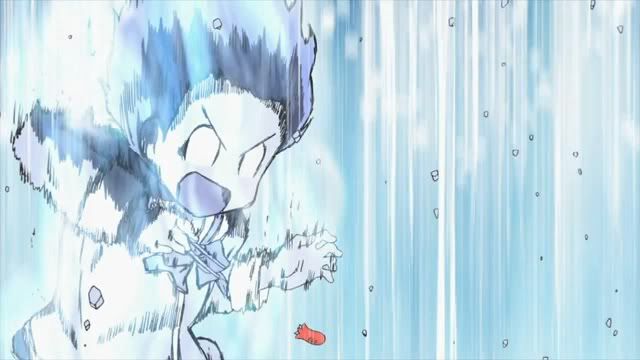
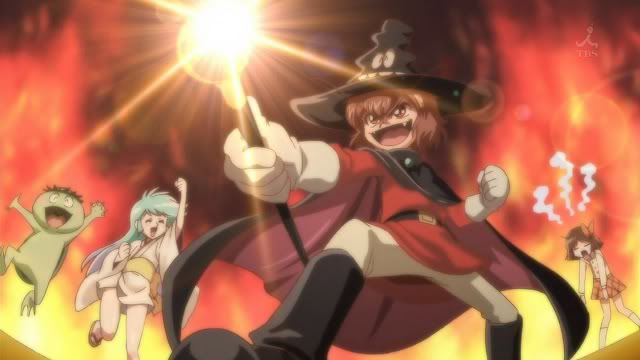
Monsters are coming to the human world from the Hell in order to get human spirits. As people's minds are getting dirty, being attracted by the dirty spirits, the monsters break the rule to go to the human world. Tsutomu, a boy who goes to Yokai Elementary School, is suddenly assaulted by monsters. Those who save him from the monsters are Enma-kun, the son of Enma, Yukiko, a snow woman, and Kappaeru. They are members of Monster Patrol that are sent to the human world to arrest monsters.

It is hard to pin down the target demographic for this title, other than "fans of Go Nagai". The overall feel is "for kids", if you didn't mind your children watching a show with penis fencing and bared breasts being stretched across the room. The visual gags (risque stuff not withstanding) are too simple to target an adult audience, yet the jokes would fly over the heads of someone who hasn't graduated college yet. Ultimately, I may have to say that the show is designed to target specifically "Fans of Go Nagai", but fear not. It will make fans as surely as his other works did.

The animation quality is something astounding! We're talking about a high budget production movie level of graphics and quality! I have never seen anything longer than a 6 episode OVA boast of such quality of picture, and most of them tend to pale in comparison! The art style may take a little bit to get used to for the uninitiated, but everything from the motion of the characters to the shine emerging from the windows in the background screams *Expensive*! Much like Akira Toryama, Go Nagai is one who stubbornly sticks to his style like a belligerent child no matter how much it may detract from the story, but unlike Toryama his style manages to somehow fit the radical change in genre.

The story felt a little rushed. A cursory mention of a ghost in the school is given, a quick introduction of recurring extras going to the school, then BAM! Everyone has their face's stolen and the surviving girl begins the madness associated with meeting, being introduced to, then following along with the actions of the Monster Patrol. A little more time spent fleshing out the other extras might have been nice, but Go Nagai has never been one to take his time, no matter how much we might have sometimes wanted him to. That aside, the main characters had more than enough time to show off themselves and introduce their personalities and quirks.

For the guts to make a title however the hell he wanted to hell with the target audiences, and to fund the work himself (since there's no way any animation studio would devote that much capitol towards a single title) I give this show a 6.5 out of 5. They say that there is power in names, and Go Nagai proves this by having an entire 2 points added to the score on the power of his.

----

4 titles so far. 2 of them really really bad, and 2 of them uncharacteristically good. It's hard to say how the rest of the season will pan out with such a radical shift in quality to be among the first seen, but if that's the trend then I give my stamp of approval! Admittedly, I can be biased when it comes to titles associated with certain famous members of the industry (Masami Obari, Go Nagai, Rumiko Takahashi, and CLAMP to name a few).
Stay tuned for introduction reviews to other spring titles.
'Ben

Friday, July 9, 2010

Last Caress – Hellsing Volume #10 Review


A year-and-a-half can build mighty powerful expectations, the types of impossible hopes and desires even the most talented individual could never completely fulfill. Kohta Hirano is a very fine manga-ka. He has an artistic style that slams you in the face like a freight train and a willingness (or maybe lack of restraint) to lose himself in absurdity for the sake of telling an entertaining tale. But even with his considerable talent, Mr. Hirano is still more the court jester than master storyteller, one possibly hamstrung by a medium demanding lighting-fast output and oftentimes immediate positive feedback.

In the intervening period between Hellsing Volume #9 and this climatic Volume #10, I chose to avoid any mention of the ending, wanting instead to go into this book a blank slate, looking for a pure reading experience. With this in mind, Hellsing Volume #10, taken alone, presents a decidedly rushed summation of the decisive battle between the Hellsing organization’s remnants and Millennium’s freakish super monsters and hoard of nazi-vampiric ghouls. It’s not a particularly satisfying read, nor does it deliver any especially memorable moments.

To be fair, one should remember manga is made for Japanese audiences who can follow a series, before ever compiled into tankoubon, through fairly regular magazine installments—they receive a more natural exposure to a story’s ebb and flow than U.S. consumers with our irregularly released graphic novels.

As a whole, Hellsing has always moved at an electric pace, speeding through material and storylines, while abandoning much attempt at denouement. Still, it should be considered, regardless of how events developed, the series is essentially relating a single encapsulated narrative over ten distinct volumes. The first two books are largely autonomous, introducing characters and establishing concepts, but by the third and fourth we’re already delving into issues involving the Millennium group; and volume five sparks the remaining events that carry us through the rest of the series.

Possibly due to manga’s unique publishing nature, and stresses placed on creators to meet insane deadlines, there often seems to be a tendency of titles evolving into their stories, instead of having well-planned dramatic arcs. In the case of Hellsing, the resulting product has been somewhat lopsided. Before ever reaching these closing chapters, four books have been entirely devoted to Millennium’s invasion of London and the ensuing battle. That’s a ton of pages detailing scant else besides carnage and death, all leading into this last tome tasked with an unenviable job of resolving the remaining mess. Wrangling the existing plot together and creating a smooth resolution isn’t helped, either, when the three main protagonists are all presented in their own self-contained vignettes.

Volume #10 essentially stitches together the final throws of each character’s ordeal: Alucard faces-off against the traitorous Walter, Seras struggles to overcome the superior fighting prowess of a Nazi werewolf, and Integra pushes towards her fated confrontation with the Major. Even though this trio may share a similar goal, the lack of cohesion about their movements leaves one with the impression of jumping between three separate stories.

Further complicating matters is the climax of their individual trials came in the preceding book—Volume #10 is merely on clean-up duty. Alucard (as has been his routine throughout the manga) was going easy on the physically youthful butler—and besides, his true rival was the now-defeated Alexander Anderson, taking a good deal of wind out of this battle from the start; Seras had already found the inner resolve to vanquish her beastly opponent; and there was never any doubt who would win in a physical confrontation between Integra and the Major, it was only a matter of the steely heroine remaining alive long enough mount her attack on the bloated warmonger’s zeppelin. Much as compiling these portions is an obvious necessity, when they comprise the entire contents of a terminal text, what ultimately exists is far from a compelling read.

There is a slight unexpected twist, involving the crimson-clad bloodsucker and a certain Nazi catboy, but the turn is employed in such a forced manner and so late in the proceedings it provides little impact on the occult war that has decimated the misty British city. Sadly, this minor episode seems to exist purely as an excuse to add a bit more meat to the volume’s flagging epilogue, which shoots us about two decades into a future where Millennium’s chaos has been cleansed and Hellsing’s ranks have mostly been restocked.

I do appreciate Hirano not ending things on a dour note, an affliction I find unduly plagues too many a manga and anime. Hellsing isn’t meant to be highbrow stuff, and while one can legitimately question whether the battle in London should have raged across such a vast quantity of pages, the series overall has been just as good a piece of horror business as anything else you’ll find throughout the comic book medium. It’s just a shame the chapters in these last few volumes couldn’t have found themselves with a more judicious ordering, one that maintained a sense of dramatic tension and delivered a more dynamic finale.

via: John H. Zakrzewski  |  Junker Woland, a horribly delightful blog.

Thursday, July 1, 2010

Whole Lotta Shaking Goin’ On – Toradora! DVD #1 Failure


This certainly wasn’t what I intended for my first update in over a year, but right now my sinuses are getting besieged by a brigade of goopy-yellow mucus, which isn’t helping my brain focus on finishing a review of the final volume of the Hellsing manga (hopefully I’ll have this done in a day or two).

So instead of my patented overly wordy critiques of the dreadful world of Japanese comic book entertainment, I’m dishing out a quick alert on the video issues plaguing the first two anime DVD releases from NIS America, namely the relatively wonderful animated adaptation of light-novel series, Toradora!, and the fairly awful quasi-related-to-the-video-game series, Persona ~ Trinity Soul ~.

Before getting into the more meaty portions of this post, let me prefix by saying: you might want to hold-off on buying either Toradora! or Persona, as the inceptive DVD releases of both shows will be getting remastered to cure some serious visual ailments.

Wanna know more, keep reading…

For the blissfully unaware (and those who no longer care about legally procuring products), NIS America—you may know them as the USA-based arm of the outfit that keeps finding horrific new ways to port their Disgaea games onto any device that connects in some fashion to a video screen—announced back in February they’d be entering into the capsizing domestic anime market, riding on a wish and a handful of new products.

Toradora! and Persona were the initial shows on-deck, each series designed to be released over two beefy DVD collectors’ sets, loaded with artbooks, posters, and other stuff that sits on your shelf and becomes a home for dust mites. Technically, the premier DVD volumes of both anime aren’t slated to hit stores until July 6, 2010, but thanks to the magic of the Internets, people started receiving their bounties this week.

What many of these intrepid pioneers soon discovered was the encoding on the sets was far less than adequate. While various theories have been proffered concerning the cause, the end result is discs that can show an abundance of ghosting (or after images) and aliasing (or jagged edges). The issue is further complicated, though, because the severity of these issues largely depend on one’s A/V setup or computer software (for those who never like to leave their captain’s chair).

Seeing is believing, of course, so here are two links offering proof of the problems in action: Linku 1, Linku 2.

Keep in mind these are still frames. The ghosting may look extreme, but in motion and depending on the hardware/software used to watch the discs, it won’t be as noticeable (and for some, the phantom bodies apparently go by completely undetected).

Thankfully, NIS America has in the span of three days put most other US anime distributors to shame. Instead of barricading themselves in their Santa Ana-based tower with covers over head, waiting for the hoard of angry anime trolls to stop pounding on the digital doors, the usually upstanding company has already announced the sets are being remastered and that a replacement program is in the works.

Those (like myself) who haven’t yet partaken of their animated offerings can follow the quest for remastering on the following webpage: Linku.

And those with faulty discs and giant collectors’ box in-hand can get an early jump on the replacement process: Linku.

It’s always unfortunate when a young horse breaks its stride right out of the gate, but I’m glad to see NIS America isn’t calling it a day. I’m sure their quick response—to what really is a major problem in a largely hobbyist-supported market like anime DVDs—will win them much good tidings and greater financial support in the long-run.


Courtesy of JunkerWoland